




Busy weeks
Exercise snacking: short bursts that add up
No hour long sessions, no guilt: exercise snacking breaks movement into small bursts that fit a busy day and pair with our Thursday laps.
Exercise snacking is the habit of breaking movement into small, bite sized bursts: a brisk walk to the shops, a few squats while dinner heats up, stairs instead of the lift. Each one is short enough to fit into the busiest day, and together they add up to real fitness. If you keep telling yourself you have no time to train, this is the way back in.
What exercise snacking actually is
The name borrows from food. Just as a snack tides you over between meals, an exercise snack is a short burst of movement that tides you over between the bigger sessions in your week. It is the opposite of the all or nothing mindset that says a workout only counts if it lasts an hour.
The idea has caught on. Searches for "exercise snacking" in Australia have grown 91 per cent year on year, to around 170 a month (DataForSEO). More people are asking the same question you probably are: can a few short walks and stair climbs really count alongside proper runs?
The answer is yes, with one condition: the effort has to be real. A casual shuffle to the letterbox is not a snack. A brisk walk that leaves you breathing a little harder, a set of stairs climbed with purpose, a minute of squats that you actually feel: those count.
Why a few short walks count
Your body does not care whether movement arrived in one block or three. What it responds to is the total: how often your heart rate lifts, how often your muscles work, how often you get off the couch. Short bursts deliver all of that, and they come with two quiet advantages that long sessions do not.
First, they are easy to start. The reason most training plans fail is not the running, it is the getting out the door. A ten minute walk asks almost nothing of you, so it actually happens.
Second, they stack. Three brisk ten minute walks across a working day put thirty minutes of movement in your legs without a single change to your schedule. On a week when Thursday laps were never going to happen, that is the difference between a maintained routine and a lost one.
Snacks that fit a real day
You do not need a program, a mat or a change of clothes. Some bursts our members use around work and family:
- A brisk ten minute walk at lunch, out of the office and back
- Taking the stairs every time, two flights or ten
- Squats or calf raises while the kettle boils or the microwave runs
- Getting off the bus or parking one stop early and walking the rest
- A five minute walk after dinner, which also helps you sleep
- Carrying the shopping in one trip at a proper pace
How snacks and club runs fit together
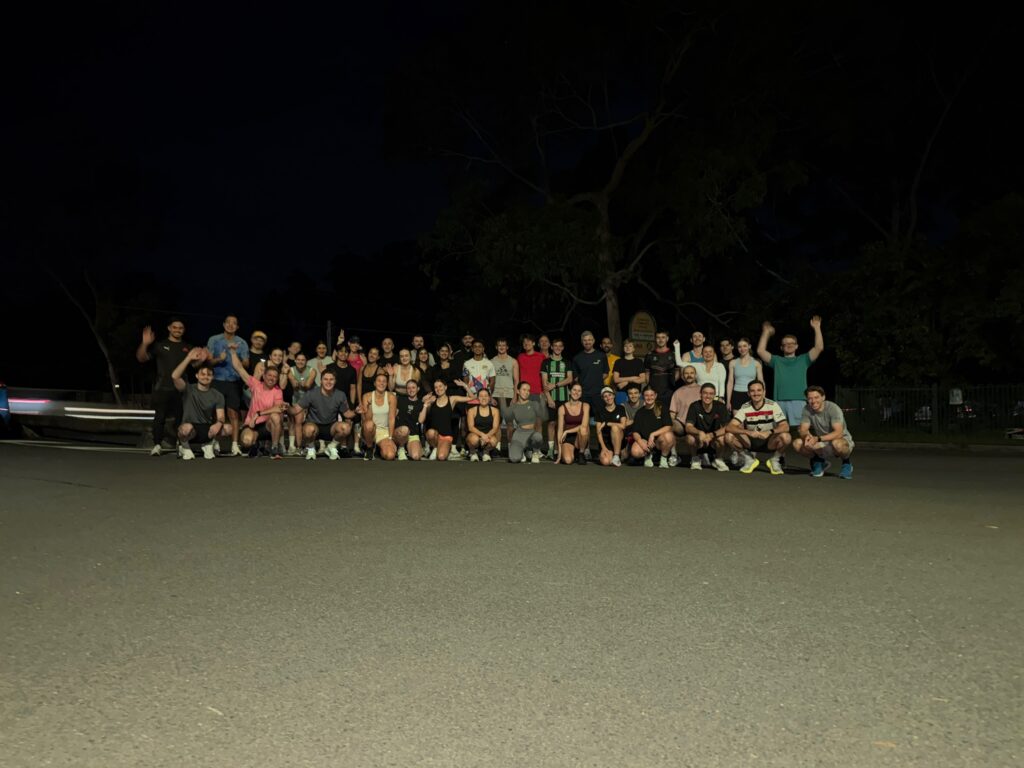
Exercise snacking is not a replacement for running with people. It is what keeps you moving between runs, so the Thursday Morning Run feels like a catch up rather than a shock to the system. Our runs come in distance options for exactly this reason: the Thursday Morning Run at Glenhaven Oval offers 2.5 km or 5 km, one or two laps, and the Tuesday Night Run at Castle Hill Showground offers 3 km or 6 km. One lap is a full run in its own right.
So the shape of a realistic week might be a couple of short walks on the days you work late, one lap with the club on Thursday morning, coffee and a sweet treat afterwards, and stairs and squats scattered through the rest. That is a training week. It just does not look like one in a diary.
If you are starting from nothing, pair the snacks with our walk to run progression plan, which builds from walk breaks to one full lap at a club run. And if you have not laced up in years, how to start running when you are completely unfit meets you where you are.
A simple week when time is tight
Here is what a week of exercise snacking looks like next to one club run. Adjust freely; the point is that everything on this list survives a bad week.
| Day | What you do | How long |
|---|---|---|
| Monday | Brisk walk at lunch | 10 minutes |
| Tuesday | Rest, or a five minute walk after dinner | 5 minutes |
| Wednesday | Stairs instead of the lift, plus squats while dinner cooks | About 10 minutes |
| Thursday | Thursday Morning Run at Glenhaven Oval, one or two 2.5 km laps | Meet 5:45am, start 6:00am |
| Friday | Rest, or calf raises while the kettle boils | About 5 minutes |
| Saturday | Walk the shops at a proper pace | 10 to 15 minutes |
| Sunday | Anything you feel like, or nothing at all | Your call |
Getting started this week
Pick two snacks from the list above and do them on the next two working days. That is the whole assignment. Once the habit is there, add the club run: make a free HRC+ account at hillsrunclub.com/hrc-plus and register for the run that suits you on our runs page. The Thursday Morning Run meets at 5:45am for a 6:00am start at Glenhaven Oval, and the Tuesday Night Run meets at 6:45pm for a 7:00pm start at Castle Hill Showground, under the lights. Walkers are welcome at both.
You do not need to arrive fit. You need to arrive. The snacks get you to the start line; the group is why you keep coming back.
It means short bursts of movement spread through the day instead of one long session: a brisk ten minute walk, a set of stairs, a minute of squats. Each burst is small, but they add up to real training.
Yes, when the effort is real. A walk that leaves you breathing a little harder counts. Three brisk ten minute walks in a day is thirty minutes of movement your body registers, whether or not it came in one block.
A few minutes is enough if you push the effort slightly: brisk rather than strolling, stairs climbed with purpose. The habit of showing up matters more than the clock.
They work best together. Snacks keep you moving between runs so the club run feels good instead of painful, and one 2.5 km lap on a Thursday morning is a full run in its own right, never a warm up for a longer one.
Make a free HRC+ account at hillsrunclub.com/hrc-plus and register there for each run. The Thursday Morning Run meets 5:45am for a 6:00am start at Glenhaven Oval, Glenhaven, with coffee and a sweet treat afterwards.
More from the newsroom
 19 October 2026
Ice baths after a run: the recovery ritual, explained
 19 October 2026
Are running socks worth it? What beginners should know
 19 October 2026
Why so many more people say they run or jog
 19 October 2026
The words you will hear at a run: a beginner's glossary
 19 October 2026
Running over Christmas: keep one easy lap in the week
 19 October 2026
Which running clubs in Sydney are good for making friends